Reaction Time Games: Can Mobile Games Make You Faster?
Published August 2026 · 6 min read
Type reaction time games into an app store and you will find hundreds of apps promising to sharpen your reflexes. Behind the search is a real question: if you spend twenty minutes a day dodging obstacles or tapping targets, do you actually become faster — at games, at sports, at anything? The honest answer is more specific than the marketing. Reaction speed is one of the few areas where game practice produces real, measurable improvement, quickly. It is also an area where that improvement stays narrower than most players assume. This article covers what reflex training on a phone genuinely does, which games are worth your time, and where a planning puzzle like ours honestly fits into the picture.
What Actually Improves When You Train Reaction Time
Play any reflex game for a week and your scores will climb. That part is not controversial: within-task improvement in speeded tasks is one of the most reliable findings in practice research, and much of it arrives fast. The catch is what kind of speed improved. Scientists distinguish simple reaction time — one signal, one response, like tapping when a light turns green — from choice reaction time, where you must first decide which of several responses fits, and from processing speed more broadly, the general pace at which you take in and act on information. Games mostly train the first two, and the gains are largely specific: getting fast at one game does not make you generally faster at everything, and the practiced game is where most of the benefit stays. One partial exception keeps researchers interested — the NIH-funded ACTIVE trial reported long-term benefits from speed-of-processing training in older adults, findings that are intriguing and still debated. Age-related slowing itself is real, but no game should be treated as a treatment for it. For the fuller story on training and transfer, see our article on whether puzzle games improve your brain.
Six Reflex Games Worth Playing
Each pick below trains a different flavor of speed — pure twitch, choice reaction, tracking, or timing — so the list doubles as a menu. Every game here is an established App Store title, not a brain-training subscription.
1. Super Hexagon — Closest to Pure Twitch Speed
Terry Cavanagh's minimalist survival game is the nearest thing on this list to a raw reflex test. Walls collapse toward the center from every direction, you rotate a tiny triangle through the gaps, and the game demands continuous tracking and instant course corrections at speeds that feel impossible on day one. Patterns arrive fast and rotated, so you cannot lean on memorization for long — improvement here really is a faster loop from eyes to thumbs, at least within this game. It is a paid app at $2.99 with no free-to-play mechanics, which keeps the experience clean. Surviving sixty seconds is a genuine achievement.
2. Fruit Ninja — Best for Tracking and Go/No-Go Choices
Halfbrick's slicing game trains a different kind of speed: choice reaction. Fruit and bombs fly across the screen together, and the task is not just fast swiping but fast discrimination — slice this, avoid that — while everything is in motion. Researchers call this kind of task go/no-go responding, and it is closer to everyday demands like driving than any pure tapping test, because holding back a response matters as much as making one. The modern version is free with ads and in-app purchases; Fruit Ninja Classic is the simpler original. Arcade mode, with its bomb-heavy chaos, is where the real drill lives.
3. Piano Tiles 2 — Best for Serial Choice Reaction
The tile-tapping formula is a serial choice reaction task dressed up as a rhythm game: black tiles stream down four lanes, you must hit every one without touching a white tile, and the speed climbs until your fingers give out. Songs do repeat, but at high speed you are reading and responding, not recalling — the skill being drilled is rapid visual identification paired with accurate finger placement, hundreds of times per run. It is free and heavily ad-supported, which is the usual trade for one of the cleanest speed drills available on a phone.
4. Geometry Dash — Rhythm Timing, Not Raw Reaction
RobTop's rhythm platformer is the game most people name first in this genre, and it is a usefully deceptive example. Your square jumps spikes in time with the music, and the timing windows are brutally tight — but every level is fixed, so a large share of the skill is memorizing what comes next and executing it on rhythm. That makes Geometry Dash a trainer of anticipatory timing more than reaction: you get faster because you know what is coming, not because your nervous system sped up. It is a paid app at $3.99, with free Lite versions to test whether that difficulty is your kind of fun.
5. Color Switch — Best for Timing and Anticipation
The obstacle-dodging classic gives every tap a timing judgment: your ball can only pass through the segment of each rotating obstacle that matches its color, so you are constantly reading rotation speed and committing at the right instant. The trained skill is anticipation against a moving window, plus instant adjustment when your color changes mid-run. It is free with ads, and runs are short enough that failure costs seconds. As a pure timing drill wrapped in a simple arcade loop, it earns its spot.
6. Crossy Road — Gentlest Entry, Real Decision Timing
The endless road-crossing hit is the forgiving pick, but it is still fundamentally a timing game: every hop across a lane is a judgment about the speed and gap of oncoming traffic, and hesitating is punished as surely as rushing. What it exercises is decision timing — go now or wait — repeated constantly with instant feedback, plus a little route planning across rivers and rail lines. It is free with ads, and its low frustration ceiling makes it the right choice if the other games here feel punishing rather than fun.
Where Arrow Puzzles Fit In
We will be upfront: Arrow Jam Go is not a reflex game. It is a planning puzzle — colored arrows slide in the direction they face, escape only when nothing blocks them, and the challenge is working out the release order before you tap. There is no timer, and nothing on the board moves until you do. But there is a kind of speed it exercises, and it is not twitch. Dense boards reward fast visual scanning: reading dozens of arrows at a glance, spotting which lanes are open, and seeing the dependency chain quickly. That is choice and perception, not raw reaction — closer to the reading you do before a chess move than the tap you make in Super Hexagon.
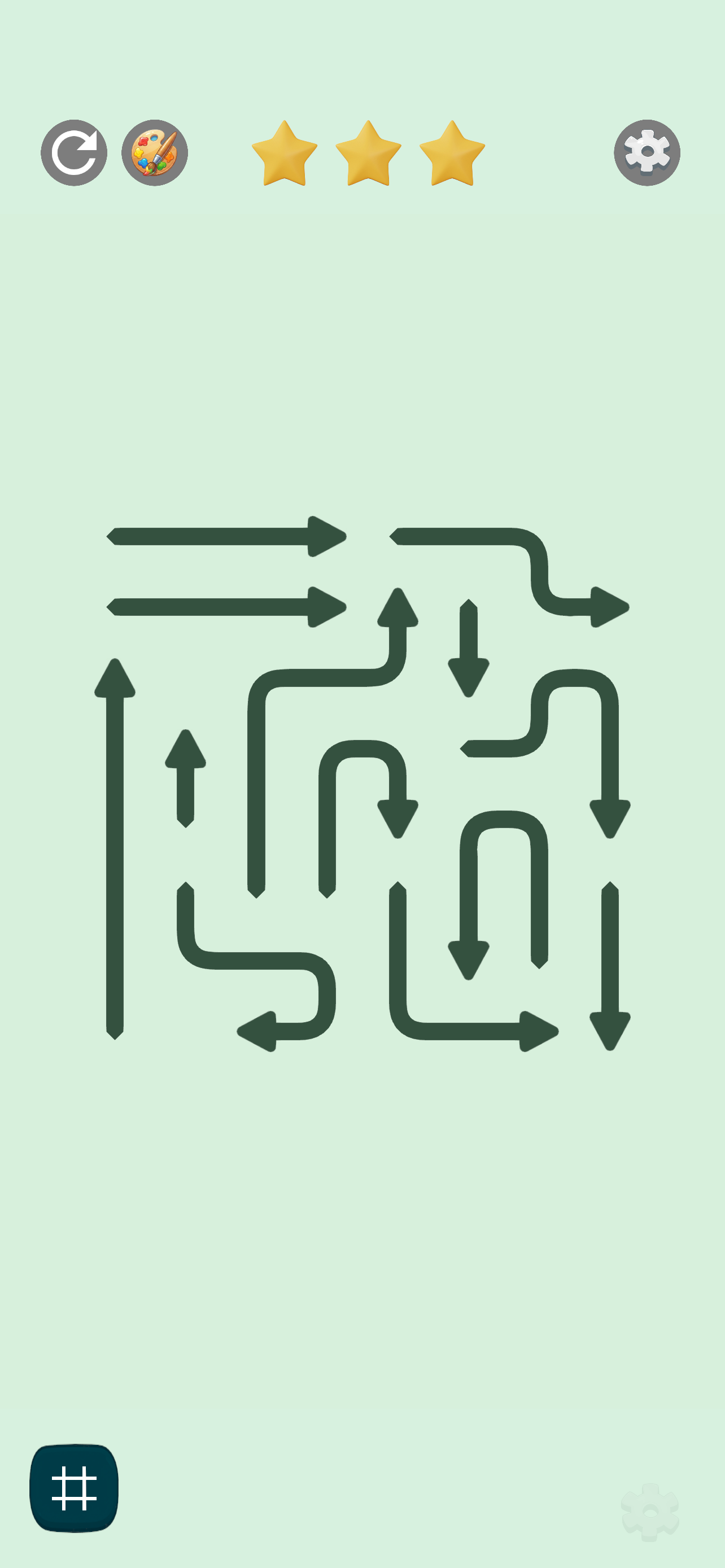
The modes with hearts sharpen that skill in a way a timer never could: mistakes cost hearts, so there is no pressure to tap fast — only pressure to read fast and tap right. You learn to scan the board quickly precisely because acting on a half-read board is what loses. So here is the honest positioning. If you want twitch speed, play the games above; they are built for it. If you want fast, accurate reading under pressure — seeing the structure of a messy board in seconds and committing without a wasted move — that is what arrow puzzles exercise, and the hardest arrow boards punish careless scanning as brutally as any reflex game punishes a slow thumb.
How to Get the Most Out of Reflex Training
Two practical points. First, variety beats grinding: because gains are task-specific, rotating between a twitch game, a choice-reaction game, and a timing game gives you a broader workout than a thousand runs of any single one — and it stays fun longer, which is what actually keeps you practicing. Second, the biggest lever on your reaction time is not an app at all. Being tired, sleep-deprived, or distracted slows anyone down more than any game will speed them up, which is common knowledge to anyone who has played the same level exhausted and rested. Sleep well, play varied, enjoy the games for what they are, and treat the score improvements as what they honestly are: proof you got better at something specific and hard.
Prefer challenges that test thinking over thumbs? See our picks in best brain test games or dig into what puzzle games actually do for your brain.