The Hardest Arrow Games: Most Difficult Arrow Puzzles (2026)
Published August 2026 · 7 min read
English · 日本語 · Deutsch · Français · 한국어 · 中文
"What is the hardest arrow game?" is a question players genuinely search for, and it deserves a straight answer rather than a listicle of whatever is trending. Here is ours: for pure planning difficulty, the hardest arrow experience we know is Nightmare mode in our own Arrow Jam Go, and we will make the case for that honestly below. But "hard" is not one thing. An arrow puzzle can be difficult because the logic runs deep, because the board hides information from you, or simply because it is exhausting to read. The most challenging arrow games each lean on a different one of those levers, so the real answer depends on which kind of difficulty you are actually looking for. This article breaks down what makes an arrow puzzle hard in the first place, then ranks the games that genuinely deliver it.
What Actually Makes an Arrow Puzzle Hard
The first and deepest lever is dependency depth. Every arrow game is secretly a graph: arrow A cannot escape until B clears its lane, B is pinned behind C, and C is waiting on something else entirely. Easy levels keep those chains one or two links long, so tapping whatever looks loose works fine. Hard levels stretch chains far enough that you must plan an order of operations across the whole board, and a wrong early tap can leave you staring at a jam you created yourself. The second lever is board density. When a level opens with plenty of free arrows, you always have a safe move and the puzzle solves itself in waves. When almost every arrow starts blocked and only a handful of taps are legal, each of those openings becomes a commitment, and the difficulty jumps even if the chains themselves are not longer.
The third lever is visual parsing. Bent arrows that cross several lanes are much harder to read than straight ones, because the cell that blocks an escape path may belong to an arrow whose head is nowhere near it. On a dense board, simply seeing the true state of every lane at a glance is a skill, and games can dial difficulty up just by making the board harder to read. Finally, 3D arrow games add a fourth lever that flat games cannot: hidden information. When the puzzle is a solid object, some faces are always turned away from you, so part of the challenge is rotating, scanning, and building a mental model of geometry you cannot see all at once. The rankings below judge each game against these four axes, because they are what separate a genuinely difficult arrow game from one that merely looks busy.
1. Arrow Jam Go — Nightmare Mode
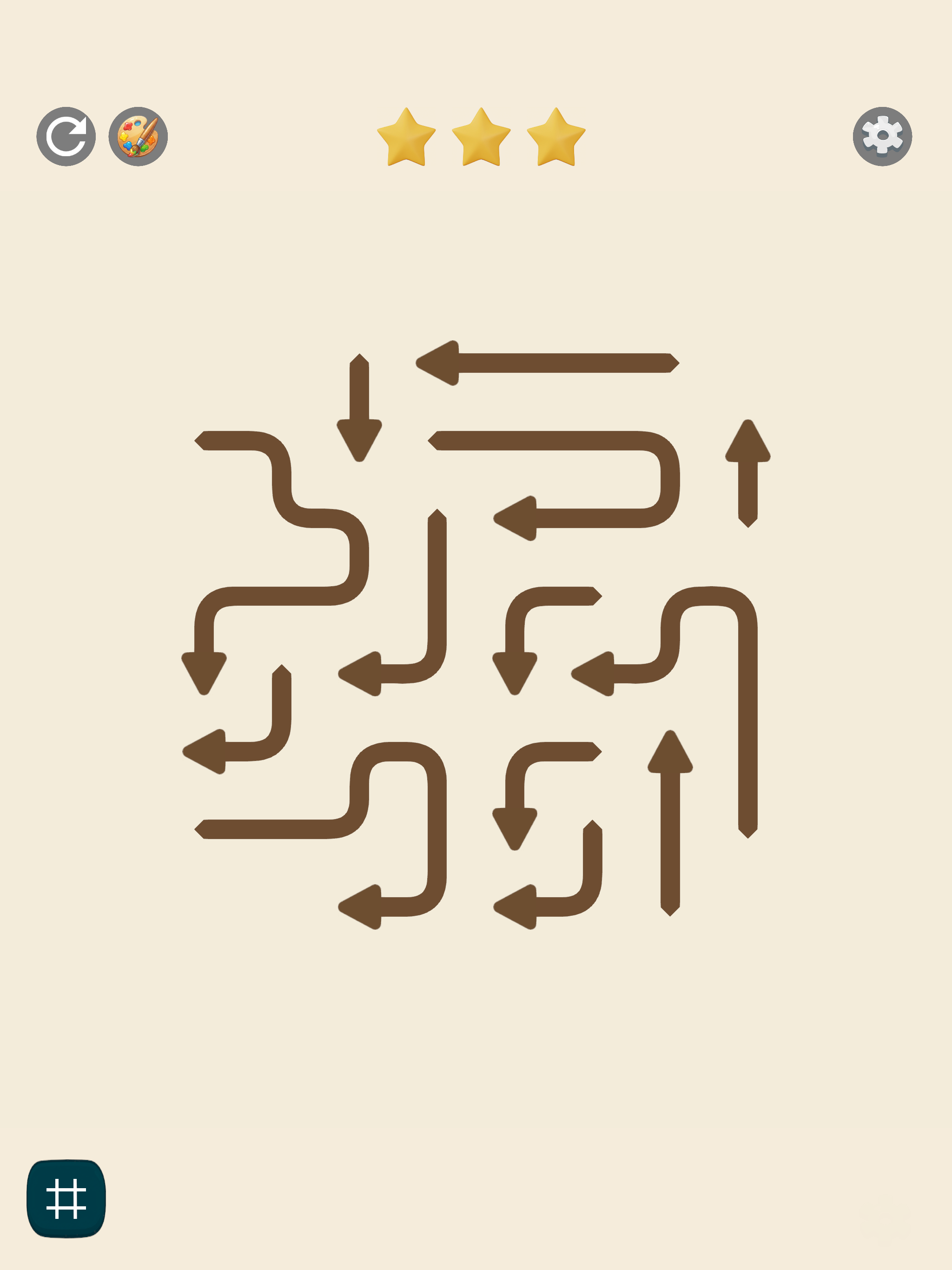
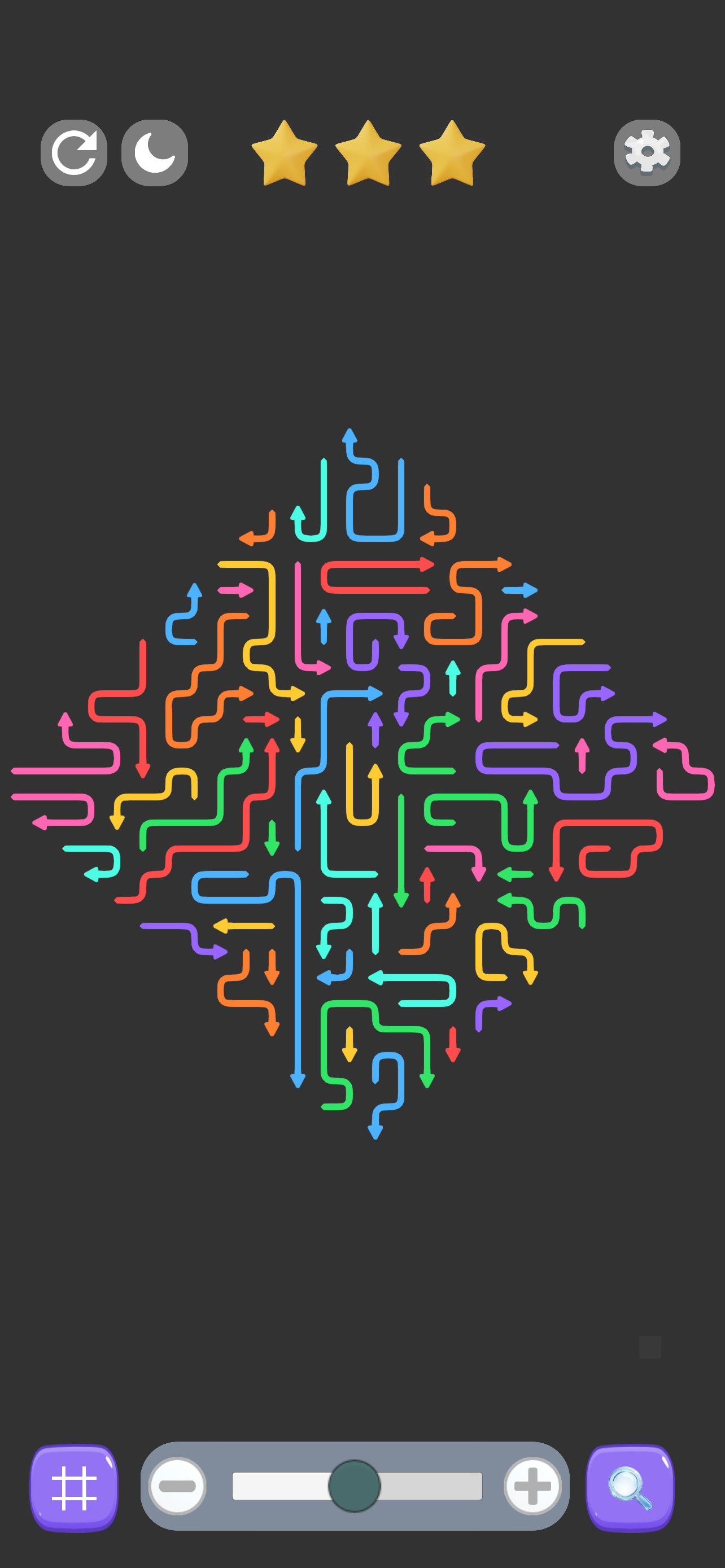
We make Arrow Jam Go, so treat this entry as a claim you can verify rather than a neutral review. Nightmare mode is the hardest planning-difficulty arrow experience we know of. The boards are larger and much denser than anything in the standard modes, nearly every arrow starts with something in its path, and the dependency chains run deep: freeing one arrow routinely requires clearing four or five others in a specific order first. Hearts raise the stakes, because a blocked tap costs a life, so guessing is punished and reading is rewarded. The safety net is real too: unlimited undo and free hints mean the difficulty comes entirely from the puzzle, never from the meta around it. With 7000+ levels feeding into it, the ramp toward Nightmare is long enough that when the wall arrives, it is a fair one.
2. Arrows: Puzzle Sorting Game
Lessmore's Arrows is one of the stronger flat-board entries in the genre, and its difficulty is earned the honest way: through the curve. Early levels are the usual free-arrow warmups, but the later boards get genuinely dense, with enough arrows packed into the grid that escape order stops being obvious and starts requiring an actual read of the board. It does not spike unfairly; the difficulty climbs level over level, which makes it a good test of whether your sequencing skills are improving or you have just been coasting on easy layouts.
3. Tap Away
Tap Away moves the arrow puzzle into 3D, and that single change creates a different kind of hard. Because the blocks form a solid structure, you can never see the whole puzzle at once; faces are hidden until you rotate the camera, so the core challenge becomes information gathering. Finding the block that is actually free right now matters more than planning six moves ahead. If you judge difficulty by depth of planning, Tap Away is milder than the dense 2D games. If you judge it by how much the game hides from you at any given moment, it belongs on this list.
4. CubeAway - 3DPuzzle
CubeAway wraps maze-like bent arrows around the surface of a 3D cube, and its difficulty is almost entirely a tracing problem. A single arrow can wind across multiple faces before its head finally points off into space, so working out whether a tap will succeed means following a snaking path around corners you cannot see from one angle. It is closer to a visual endurance test than a sequencing puzzle: the dependency logic is usually shallow, but the act of reading each arrow correctly is genuinely demanding, and misreads feel very easy to make.
5. Unpuzzle
Unpuzzle strips the genre down to nothing but dependency order: quiet, flat boards of interlocked tiles that must leave in the correct sequence, with no lives, no timer, and no decoration. Most of its levels are gentle, which is part of the design, but some of the later boards are legitimately knotty, with interlocks that take real staring to untangle. It earns its place here as proof that the underlying logic can be hard entirely on its own, without density or 3D tricks. Think of it as the hardest version of the purest ruleset.
6. Unblock-Style Games (Rush Hour Descendants)
Titles like Unblock Me descend from the physical Rush Hour board game, and they are the slow-burn heavyweights of this family. Pieces slide back and forth along their own axis instead of committing to one escape direction, which makes individual moves forgiving but whole solutions deeper: hard boards demand long sequences of shuffling before the exit path opens. The expert packs in the established unblock games get legitimately difficult, in a chewy, deliberate way that rewards sitting with one board for several minutes. It is a different tempo of hard, closer to a logic workbook than an action puzzle.
The Verdict: Which Hard Do You Want?
Match the game to the kind of difficulty you enjoy. If you want deep planning, where the challenge is holding long dependency chains in your head and committing to an order, dense 2D boards are the answer, and Nightmare mode in Arrow Jam Go is the strongest version of it we know, with Lessmore's Arrows and late-game Unpuzzle close behind. If you want hidden information, where the puzzle fights your eyes as much as your logic, go 3D with Tap Away or CubeAway. If you want slow deduction, the kind you sip rather than solve, the unblock-style games are the pick. And if you do take on Nightmare and hit the wall, that is the intended experience; our Nightmare mode guide covers the strategies for actually beating it, because this article is about which games are hard, not how to win them.
So, What Is the Most Challenging Arrow Escape Puzzle Game?
If we have to give one answer to the question: for players who define challenging as planning, Arrow Jam Go's Nightmare mode is the most challenging arrow escape puzzle experience we know of. The boards are larger and denser than anything in the standard progression, nearly every arrow starts blocked, and the dependency chains run deep enough that you have to commit to an escape order several moves ahead — exactly the four difficulty levers this article started with, all pushed at once. If your definition of challenging is a fight with geometry instead, a 3D cube like Tap Away or CubeAway will challenge you in a way no flat board can. Either way, the question has a real answer only once you decide which kind of difficulty you are actually chasing.
Building up to the hard stuff? Sharpen your fundamentals with our Arrow Puzzle Tips guide first.
Looking for quality rather than pure difficulty? See our broader roundup of the best arrow puzzle games of 2026.
Want to test yourself right now? Play the arrow puzzle online free — 300 levels in your browser, no download — or turn the 3D arrow cube.