Games to Improve Your IQ: What Actually Works (2026)
Published August 2026 · 7 min read
"Games to improve IQ" is one of the most searched phrases in the puzzle category, and most pages that rank for it pretend the question is simpler than it is. Here is our answer up front: no game has been shown to raise your IQ in a lasting, general way, and any app promising otherwise is selling something. What games can do is narrower and still worth having: they exercise reasoning, planning, working memory, and spatial thinking, the way a run exercises your legs. Below is the honest verdict, then seven games that each work a specific reasoning skill, including our own, placed where it belongs.
The Honest Answer: No Game Raises Your IQ
IQ is a score on a standardized test, normed against a large population and administered under controlled conditions. So "improving your IQ" means performing better on that kind of instrument in general, and no consumer game has been shown to do that in a lasting way. What is real is the practice effect: do a kind of task repeatedly and you get better at that task and at tasks that closely resemble it. A month of sudoku makes you a much better sudoku player, and probably a little better at similar constraint puzzles. That is a genuine gain, but it is not being smarter in general, and the honest word for what a game does to your reasoning is "exercise," not "boost." For what a score actually means, our article on IQ test games covers it.
What the Working-Memory Training Research Found
The closest science has come to a "game that raises IQ" is working-memory training, usually a task called n-back, where you flag when the item on screen matches one from a few steps earlier. Early studies reported that people who trained on it improved on tests of fluid reasoning. Later, larger studies with stricter control groups found much smaller gains, and reviews pooling the literature concluded that people mostly got better at the training task itself, with little reliable transfer to general intelligence measures. Researchers still debate how to read that evidence. The takeaway is not that the training does nothing; it is that the strongest claims did not survive the strongest tests. Our essay on whether puzzle games improve your brain covers that research picture without the marketing.
Does Chess Increase IQ?
Chess gets asked about most. Strong chess players do tend to score above average on cognitive tests, but the correlation runs partly the other way: people with strong reasoning skills are more likely to take up chess and stick with it. Studies of chess lessons in schools have reported modest gains on reasoning and math measures, and reviewers have noted that the better-controlled studies show smaller effects, the same pattern seen across brain training. So the fair answer is that chess has not been shown to raise IQ, while remaining one of the most demanding reasoning workouts available. Chess makes you better at chess, and that thinking is worth doing for its own sake.
7 Games That Genuinely Exercise Reasoning
Each game below was chosen because it exercises one specific skill, and every title was verified on the App Store before we named it. They are ordered roughly from deepest to lightest, which is why our own game sits in the back half.
1. Chess.com - Play and Learn (Calculation and Planning)
Chess.com's app is the obvious first pick, for calculation. Working out a line means holding a branching tree of moves in your head, judging each end position, and discarding the branches that fail, as direct a working-memory and planning exercise as games offer. The opponent is what no solo puzzle replicates: your plan has to survive someone trying to break it. The app is free to play, with games at any strength and daily tactics puzzles; the paid membership mostly unlocks lessons and deeper analysis. Expect to get better at chess, not at everything.
2. Sudoku.com - Number Games (Deductive Logic)
Sudoku is the cleanest deductive-logic exercise on a phone. Every digit you place follows necessarily from the constraints, so a well-made grid never asks you to guess, and the harder tiers demand chains of inference rather than a single scan. Easybrain's Sudoku.com has difficulty levels from beginner to expert, pencil marks for tracking candidates, and a daily challenge. It is free and ad-supported, with ads between puzzles and a paid option to remove them. The skill it trains is bookkeeping under logic: seeing what a cell cannot be, and letting eliminations cascade.
3. Logic Grid Puzzles (Deduction and Working Memory)
These are the classic grid puzzles: a list of clues about who owns which pet, and a grid where you cross off every combination the clues rule out until one arrangement survives. It is the closest thing here to the deductive-reasoning items on formal tests, an IQ workout without the measurement. Egghead Games' Logic Grid Puzzles is a no-nonsense app for it; the free download includes a starter set, and larger puzzle packs are sold in-app. The skill is disciplined elimination: holding several partial deductions at once and never marking a cell you cannot justify.
4. Baba Is You (Rule Manipulation)
Baba Is You is the deepest pure-logic game on this list, and it trains something no other pick touches: reasoning about the rules themselves. Each level's rules are written on the board as word blocks, and pushing those words around rewrites them. Solving a level means asking what the rules would have to become for the level to be solvable, then engineering it. It is abstraction and hypothesis testing, literally. Hempuli's mobile port is a paid app with no ads and no energy system. Expect to be stuck; being stuck is the point.
5. Lazors (Spatial Reasoning)
Lazors is a light-beam puzzle: place a limited set of mirror, glass, and crystal blocks so a laser bounces through every target. The exercise is spatial reasoning, specifically mental simulation, because the only efficient way to solve a board is to predict where a beam goes after two or three reflections before placing anything. The block budget is tight enough that trial and error stalls on later boards. Pyrosphere's game is free and ad-supported, with hundreds of levels and a fair curve, and the later packs genuinely tire the visual imagination.
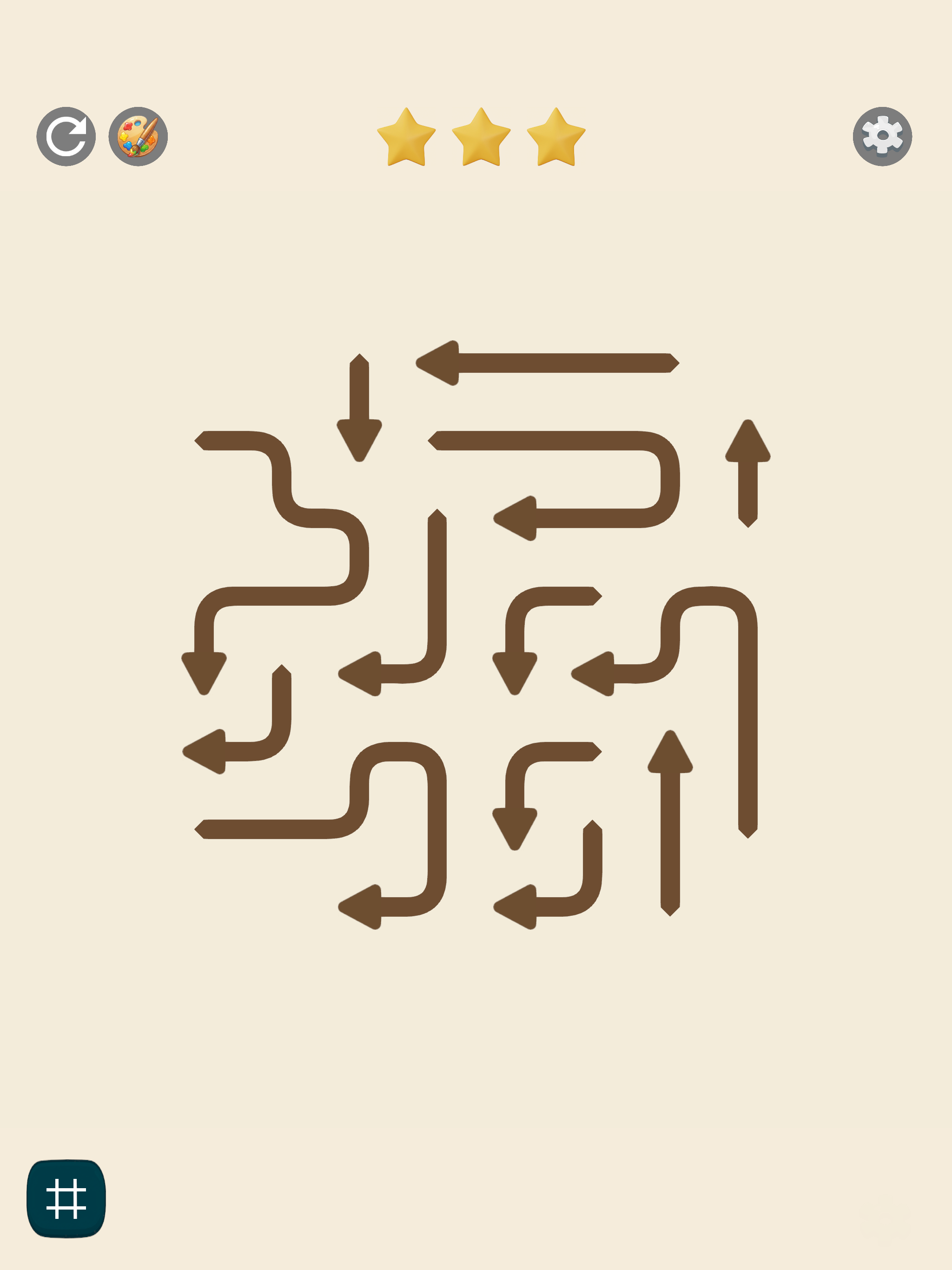
6. Arrow Jam Go! Tap Escape (Dependency-Order Planning)
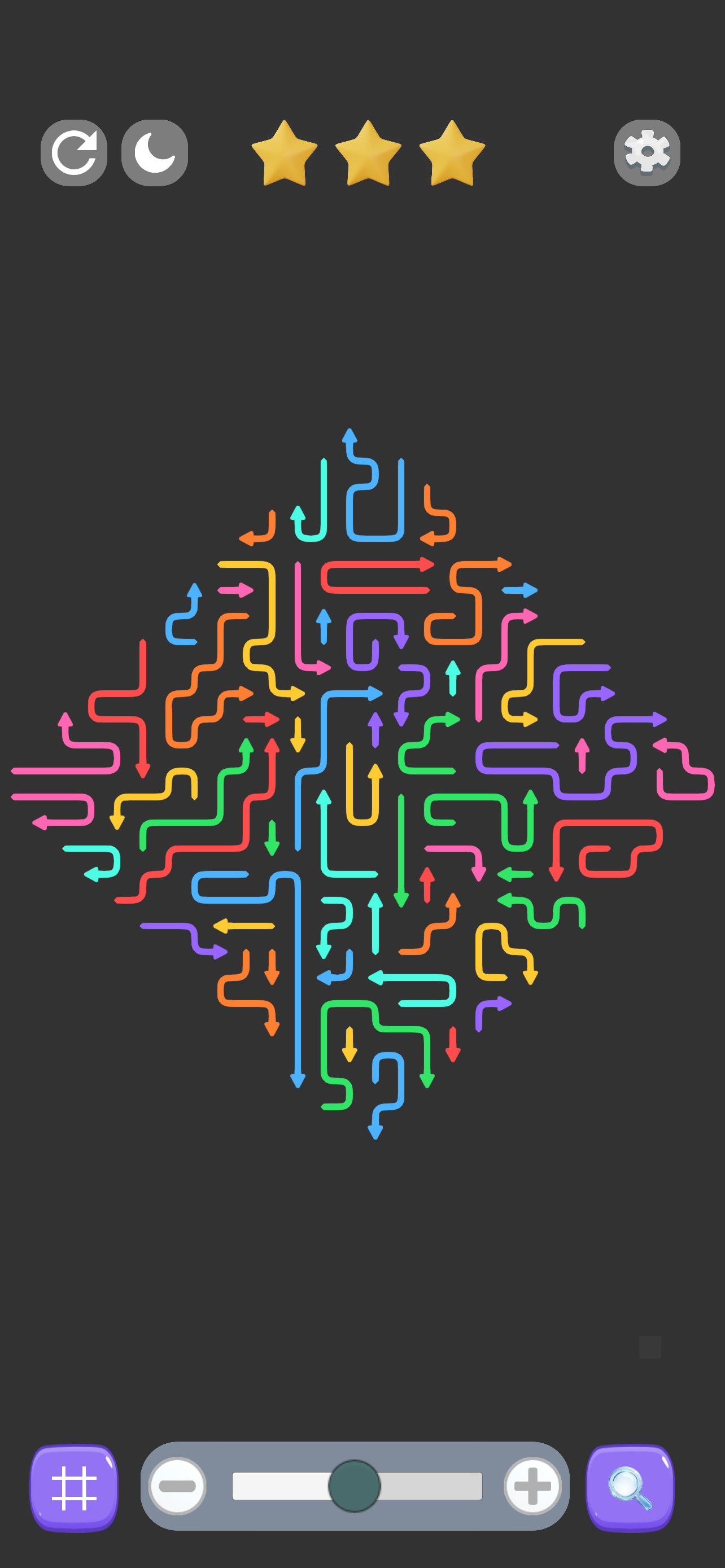
Our own game, placed sixth on purpose because it is lighter than chess or Baba Is You. What Arrow Jam Go exercises is dependency-order planning. Every arrow escapes only if its path is clear, so a level is really the question of which arrow must leave first, which arrows that frees, and how deep the chain runs. Nightmare mode pushes that into deep multi-step planning. It is free, with 7000+ levels, ads only between levels and never during play, a one-time ad removal, free unlimited hints and undo, and offline play. It will make you plan. It will not raise your IQ.
7. Two Dots - Connect the Colors (Pattern Recognition)
Two Dots is the lightest entry here, included with that caveat stated plainly. You connect same-colored dots to clear them, and closing a square clears every dot of that color, so the real skill is spotting square-able patterns and budgeting a limited move count toward the level goal. That is genuine pattern recognition and short-horizon planning, but the board refills randomly, and randomness caps how much reasoning a level can demand. Treat it as a warm-up, not a workout. Playdots' game is free with lives, ads, and in-app purchases.
What to Actually Do If You Want to Feel Sharper
If the goal is to feel sharper rather than to chase a number, the advice is common sense. Play for variety, because practice gains stay close to the task you practice: a week of sudoku, then logic grids, then a spatial puzzle exercises more of your reasoning than a month of any one of them. Play things hard enough to make you stop and stare before you touch anything; a puzzle you solve on autopilot asks nothing of you. Stop when you are tired, and sleep, since nobody reasons well without it. And keep your expectations honest: the reward is the habit of thinking carefully and the enjoyment of a hard problem giving way, which beats any score a website could invent.
Want the trick-question end of the genre instead? See our ranking of the best brain test games.
Ready for boards that genuinely demand planning? Our roundup of the hardest arrow games ranks the most difficult ones honestly.