Best Brain Games for Students: Study-Break Puzzles (2026)
Published August 2026 · 6 min read
Most lists of brain games for students are really just lists of brain games with the word "students" bolted on. That misses the actual question. A student is not asking which puzzle is the most rigorous; they are asking what they can play for five minutes between classes, on the bus, or in the gap between two chapters that resets their head without eating the whole evening. That is a question about context, not cognition. So the picks below were chosen for how a game behaves in a short break: whether it ends cleanly, whether it works in a lecture hall with no signal, and whether it lets you leave. We make one of these games ourselves, so we have an obvious interest, and we state the trade-offs of every pick, ours included. Whether you are a teen in high school, a university student, or a young adult who never stopped doing puzzles on the commute, the same criteria apply.
What a Study-Break Game Actually Has to Do
The first requirement is a natural stopping point. A good break game is built from small, self-contained units, one level or one board, that take a minute or two and then hand you a clean moment to put the phone down. Games that flow endlessly, or dangle the next reward the instant you finish, are designed to defeat exactly that moment. The second requirement is that it works offline. Lecture halls, subways, dorm rooms with overloaded Wi-Fi, and the back of a bus are the real places students play, and a game that needs a server before the first level is useless in half of them. We keep a separate list of puzzle games that work without Wi-Fi if that is the deciding factor for you.
The third requirement is the one most lists skip: the game must not hijack your attention. Streak counters that punish a missed day, energy timers that ration your play into scheduled visits, and notifications engineered to pull you back at 11 p.m. are all features built to own your time. A study-break game should be something you pick up on your terms and forget about until the next break. Finally, ads should be fair: between levels, never during a puzzle, and never placed where a stray tap launches something. Every game below is measured against those four things, and where one falls short we say so.
Study Breaks, Honestly
Here is where the hype usually goes. A short, low-stakes puzzle is a reasonable way to reset between blocks of work: it pulls your attention onto something small and finishable, and a solved board is a cleaner place to end a break than a half-read feed. That is a modest, believable benefit, and it is the only one we will claim. No game on this list makes you learn faster, and none of them will raise your grades, sharpen your memory, or make you smarter in any general sense. The evidence on brain training is nuanced, but the honest summary is that people get better at the specific game they practice and not much else; we go through the details in Do puzzle games actually improve your brain?. Play these because a clean five-minute break is useful and the puzzle is enjoyable. And if a study session is going badly, a walk or a glass of water is probably a better reset than any app.
1. Arrow Jam Go! Tap Escape
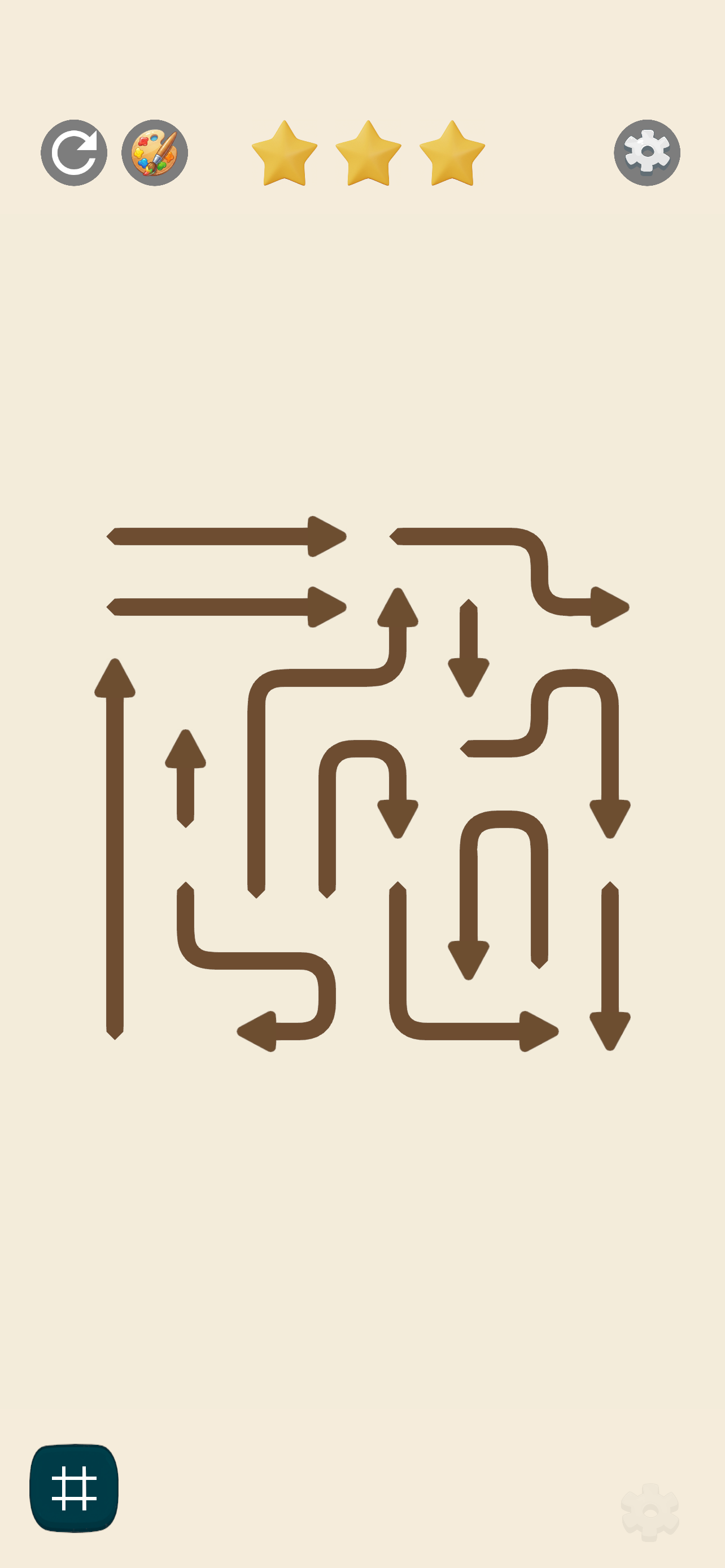
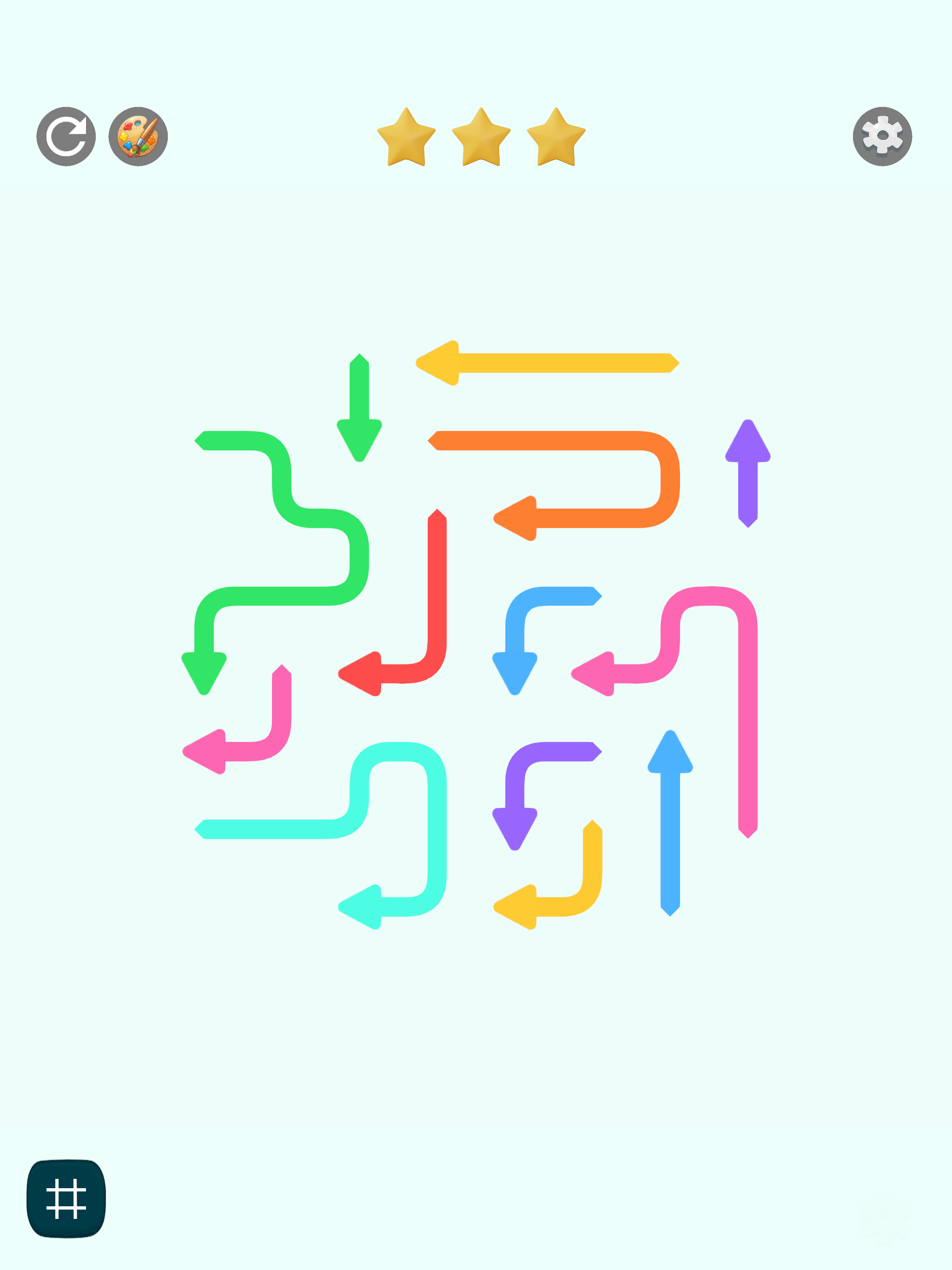
This is our game, so weigh that as you read. The board is a grid of colored arrows; tap one and it slides in the direction it faces, but only if nothing is in its path, so each level is a small ordering puzzle you read before you tap. Levels take a minute or two and end cleanly, which is about the right size for a gap between classes. It works fully offline, ads appear only between levels and never during play, and a one-time purchase removes them with no subscription. Hints and undo are free and unlimited, so a wrong tap costs nothing. There are 7,000+ levels, a Daily Challenge, and a Nightmare mode for when a break turns into a real session. What it exercises is planning and sequencing.
2. Two Dots
Two Dots from Playdots asks you to connect same-colored dots within a limited number of moves, and its levels are short and tightly designed: a minute or two each, with a square-clearing mechanic that rewards a little planning over greedy matching. It is here for the quality of those levels, with the trade-off stated plainly. It is a mainstream free-to-play game, so expect a lives system that refills over time, event pop-ups, and optional ads for extra moves. If that meta annoys you, it fails the attention test; if you can tune it out, the puzzles underneath are still some of the best in the match genre.
3. Lazors
Lazors by Pyrosphere is a quiet geometry puzzle: place reflecting blocks so a laser beam bounces through every target. Each level is a single small board that takes anywhere from thirty seconds to a few minutes, with no timer, no lives, and nothing to maintain between sessions. In our experience it plays fine without a connection. It is free with ads between levels and an optional purchase to remove them. What it exercises is spatial reasoning, predicting angles and reflections in your head before you commit, which is a genuinely different kind of thinking from most tap puzzles.
4. Unpuzzle: Tap Away & Car Out
Unpuzzle from HYPERCELL strips the escape-puzzle idea down to its bones: flat boards of interlocked tiles that must slide out in the right order, with no decoration, no lives, and no timer. Most boards take under a minute, and the later ones get pleasantly knotty. It is close to a pure sequencing exercise, working out which tile is genuinely free right now and which only looks free. It is free with ads between levels. Because each board is so small, it is one of the easiest games here to stop after exactly one puzzle, which is a real virtue in a break.
5. Tap Away 3D
Popcore's Tap Away 3D turns the same idea into a solid block structure you rotate in space. Each block flies off in the direction of its arrow if the path is clear, so the challenge is finding the block that is actually free while half the object is hidden from view. Levels take a minute or two. It is a free-to-play game with ads between levels and optional ad-watch boosters, so treat it as fair but not silent. What it exercises is 3D visualization, building a mental model of geometry you cannot see all at once, and it is a good pick if flat boards have started to feel automatic.
6. Flow Free
Flow Free from Big Duck Games has been on phones for over a decade for a reason. Connect each pair of colored dots with a pipe so that every pipe is used and every cell of the grid is filled. Small boards take seconds and the largest take several minutes, and you choose the size, so session length is entirely in your hands. It plays offline, has no lives or streaks in the standard mode, and shows ads between levels with a purchase to remove them. What it exercises is spatial planning, seeing how one route forces all the others. There is an optional time-trial mode, but nothing pushes you into it.
7. Knotwords
Knotwords, from designer Zach Gage, is the vocabulary pick. Letters are grouped into sections of a small grid, and you rearrange them so that every row and column reads as a real word: a crossword with no clues, solved by logic and word sense together. The daily puzzle takes a few minutes, and the free version gives you that puzzle without an ad-driven meta; in our experience it is monetized through an optional subscription for extra puzzle books rather than through ads. What it exercises is vocabulary and constraint reasoning, and it is the calmest game on this list.
Matching the Game to the Break
For a five-minute gap between classes, pick the game whose unit is smallest: Unpuzzle, Flow Free on a small grid, or a single Arrow Jam Go level. For a bus or train ride, offline is the deciding factor, which points to Arrow Jam Go, Flow Free, or Lazors. For the end of a long study session, when what you want is something slower and quieter, Knotwords or a big Flow Free board fits better than anything with a lives counter. And if what you actually want is a game with a ceiling, chess puzzles on Lichess, say, that is a different list; our roundup of brain test games covers the games meant to challenge you rather than rest you. Whatever you choose, the test is simple: after five minutes, can you put it down and go back to work? If the answer is no, it isn't a study-break game, however good it is.
Choosing games for a parent or grandparent instead? Our guide to brain games for seniors takes the same honest approach with a different checklist.
New to Arrow Jam Go? The rules take about a minute to learn — here's how to play.